

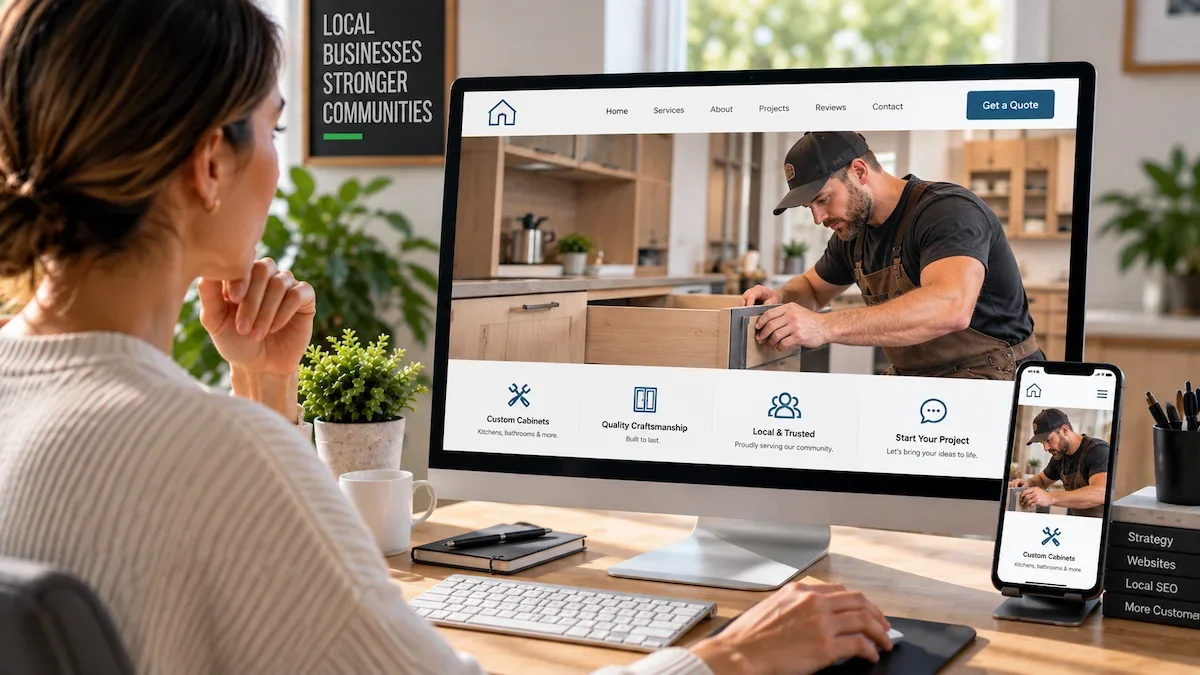
Websites for Cabinetmakers
Built to Turn Inspiration Into Qualified Inquiries
A cabinetmaker's website has to do something very different from a typical service-business website.
Your customers are not simply looking for someone who can show up tomorrow and fix a problem. They may spend weeks or months gathering ideas, comparing companies, studying photographs, thinking about materials and finishes, and deciding who they trust with a significant investment in their home.
Your website needs to support that entire decision.
At Measurable Results Consulting, we build websites for cabinetmakers and custom cabinetry companies around the way those customers actually research and choose.
That means bringing together strong visual presentation, useful information, local search visibility, first-party expertise and a clear path from inspiration to consultation.
The goal is not simply to show beautiful cabinetry.
It is to help the right customer understand why your company may be the right one to create it.
Your Cabinetry Website Has a Job to Do
Someone arriving on your website may be dreaming about a new kitchen, planning a bathroom renovation, considering built-ins, comparing wood species, wondering about painted versus natural wood, or trying to understand what custom cabinetry actually gives them that another option does not.
They may not be ready to request a quote yet.
That matters.
A strong cabinetmaker website needs to help people at several stages of the decision:
inspire them with real completed work
show the kinds of spaces and cabinetry you create
explain your design and project process
help them understand materials, finishes and construction choices
establish confidence in your craftsmanship and experience
make your service area clear
answer the questions that naturally arise before a consultation
give them an easy next step when they are ready
A gallery alone cannot do all of that.
Neither can a generic Services page.
The website needs to become part portfolio, part educational resource, part local-search platform and part conversion system.
Beautiful Photography Matters - But It Is Not the Whole Website
Cabinetmakers have one of the strongest visual advantages of any local trade.
A completed kitchen, bathroom, laundry room, bar, fireplace surround or custom built-in can immediately communicate craftsmanship, design ability and attention to detail.
We should use that advantage.
But photographs without context leave important questions unanswered.
What was built?
What materials were used?
What problem did the design solve?
Was the cabinetry custom-sized for the space?
What storage or functional considerations shaped the project?
What finish was selected?
What should a customer understand before choosing something similar?
When appropriate, adding useful first-party information around genuine project photography turns a portfolio into something much more valuable.
Customers get more than inspiration. They begin to understand how you think and work.
Search engines also gain substantially more context about the services, materials, project types and expertise represented on the website.
The best cabinetry websites do both: show the work and explain the work.
Built Around Your Cabinetmaking Business
Not every cabinet company is trying to grow in the same direction.
One may specialize heavily in kitchens. Another may have strong opportunities in bathrooms, laundry rooms, home bars, fireplaces, entertainment centres, closets or other custom woodworking.
One may manufacture cabinetry in its own shop. Another may combine design, production and installation differently. Some work primarily with homeowners, while others may also have important relationships with builders, renovators, designers or commercial clients.
Those differences should shape the website.
Before determining the structure, we want to understand:
Which project types are most important to your business?
Which work is most profitable or strategically valuable?
Who is your ideal customer?
What geographic area do you genuinely serve?
What makes your cabinetry different?
Which materials, finishes and construction methods are important to explain?
What questions do customers repeatedly ask during consultations?
Which misconceptions create problems later?
What photographs and project examples do you already have?
Where do you want the business to grow?
The website should reflect the cabinetmaking company you are building — not force your company into a generic website structure.
Project-Type Pages That Match How Customers Think
Customers often begin with the room or project they want to change.
That makes project-type content particularly important for cabinetmakers.
Depending on the business, useful pages may include:
Kitchens
Bathrooms
Laundry Rooms
Home Bars
Fireplaces
Built-In Cabinetry
Entertainment Centres
Closets
Custom Woodwork
Not every cabinetmaker needs every one of those pages.
But when a project type represents meaningful work and customers actively research it, a dedicated page can give them a much better experience than a single gallery or general cabinetry page.
A strong project page can combine completed work, practical information, design considerations, materials, storage ideas, common questions and a clear path toward a consultation.
That makes the page useful before the customer is ready to buy — which is exactly when many cabinetry decisions begin.
Materials, Finishes and Construction Are Content Opportunities
Custom cabinetry gives customers choices, and choices create questions.
Wood species, natural variation, MDF, veneers, painted surfaces, stains, door styles, hardware, cabinet construction, drawer systems, storage solutions and finishes can all influence the finished result.
Those subjects are not merely technical details.
They are part of the customer's buying decision.
A useful cabinetry website can help customers understand why maple looks and behaves differently from hickory, oak, white oak, walnut or cherry; why natural wood varies from one door to another; why a manufactured material may be the better choice for a particular finish; or why construction and hardware matter even when they are less visible.
The objective is not to turn every visitor into a cabinetmaker.
It is to give them enough good information to make more confident decisions.
That kind of first-party educational content can also demonstrate genuine expertise in a way that generic marketing copy cannot.
Show the Process, Not Just the Finished Kitchen
A finished project tells customers what you can create.
Your process helps them understand what it may be like to work with you.
For a substantial cabinetry investment, that matters.
Depending on how your company operates, useful process content might explain:
the initial consultation
measuring and site assessment
design development
drawings or visualization
material and finish selection
approvals
manufacturing
installation
adjustments and final details
care and ownership after installation
The process should reflect how the company actually works.
We do not invent a polished-sounding process because it looks good on a website.
We document the real one, improve the explanation where needed, and help customers understand what to expect.
Clarity reduces uncertainty. For a customer making a major home investment, that can be an important part of conversion.
Local Visibility for a Business Customers Need to Visit — and Trust
Cabinetry may be highly visual, but it is still a local or regional business.
Customers often want a company that can visit the home, understand the space, collaborate through design decisions, manufacture or coordinate the cabinetry, and install the finished project properly.
Your website should therefore make it clear where you work.
For cabinetmakers serving several communities, legitimate location pages may support local visibility when those pages correspond to real markets the company serves.
But changing the city name on otherwise identical pages is not a strategy we recommend.
A useful location page should have a genuine reason to exist and should help a customer in that market understand the company's services, relationship to the area and next step.
The goal is not to manufacture geographic reach.
It is to make your real service area understandable to customers and search engines.
Cabinetmaker Website Design and SEO Should Work Together
SEO should influence the architecture of a cabinetry website from the beginning.
If kitchens, bathrooms, laundry rooms, bars or custom built-ins are important parts of the business, the website structure should reflect that.
If customers regularly research materials, finishes, construction or care, those topics may deserve connected educational resources.
If specific communities are important markets, local relevance should be considered before the site is built.
That affects:
Page structure
Navigation
URLs
Headings
Internal links
Project galleries
Image information
Service and project-type pages
Educational resources
Location strategy
Mobile usability
Website performance
Building a visually attractive cabinetry website first and thinking about search visibility later can leave important opportunities buried inside galleries or broad pages.
Design, content and SEO should support one another from the beginning.
Built for the Way Cabinetry Customers Actually Search
Cabinetry searches can begin broadly and become increasingly specific as the customer learns.
Someone might start with:
custom cabinets near me
kitchen cabinets
cabinetmaker in their city
custom kitchen cabinets
Then move into questions about:
wood species
painted cabinets
cabinet finishes
door styles
storage solutions
bathroom vanities
laundry room cabinetry
custom built-ins
cabinet construction
care and maintenance
That progression creates an opportunity.
A well-structured website can meet customers at several stages of the research process and connect related information naturally.
We do not create pages simply to capture every possible keyword.
We identify legitimate customer questions and business opportunities, then create useful content where the subject deserves it.
That is better for the customer and creates a much stronger long-term website.
Trust Is Built Differently in Cabinetry
A cabinetry project can represent a significant investment and become part of a home for decades.
Customers therefore need more than a claim that you provide quality workmanship.
They need evidence.
Depending on the company, useful trust signals may include:
original project photography
detailed galleries
years of cabinetmaking experience
the number or range of projects completed, when verifiable
photographs of the actual shop and team
customer reviews
design expertise
information about materials and construction
warranties and care information
examples of unusual or challenging projects
community involvement
clear contact and business information
The strongest trust signals are usually first-party.
A photograph of your own shop says more than a generic woodworking image. A real kitchen you designed and built says more than a stock photograph. A useful explanation of natural wood variation demonstrates more expertise than saying you use 'premium materials.'
We build around what is real.
Project Galleries Should Do More Than Display Photographs
A cabinetry gallery is important, but it should not become a dead end.
Customers should be able to understand what they are looking at and move naturally toward related information.
Where the information is available, useful project context can include:
Project type
Wood species or material
Finish or colour
Door style
Special storage solutions
Design challenges
Custom features
Location or market, where appropriate
Related services or educational resources
We do not need to overload every photograph with text.
But strategically connecting real projects to useful information turns the gallery into part of the customer journey rather than a standalone image collection.
It also makes your first-party photography work harder for the business.
Mobile Matters Even for a Considered Purchase
Cabinetry customers may spend substantial time researching, but much of that research still happens on a phone.
They may discover your company through Google, open a project gallery from social media, compare companies while sitting at the kitchen table, or show a spouse or family member a design they like.
The mobile experience therefore matters.
Photography needs to remain clear and properly framed.
Text needs to be readable.
Navigation should make project types and important information easy to find.
Forms should be practical to complete.
Phone numbers, email links and consultation options should be easy to use.
A beautiful desktop website that becomes frustrating on a phone is not a finished website.
Calls to Action Should Respect the Buying Process
A person researching custom cabinetry may not be ready to request a quote after viewing one page.
That does not mean the website failed.
The website may have helped them understand a material, discover a project type, compare design possibilities or become familiar with your company.
Calls to action should therefore be visible without turning every section into a hard sell.
Depending on the company and its process, appropriate next steps might include:
Book a Consultation
Start Planning Your Cabinetry
Request an Appointment
Talk to a Designer
Contact Us
Visit the Showroom
We also believe in giving people practical ways to make contact where the business supports them — phone, form, email, text or online appointment booking.
Different customers prefer different communication methods.
Reducing unnecessary contact friction can help more of the right people take the next step.
Accessibility, Performance and Image Quality Matter
Cabinetry websites often depend heavily on photography.
That makes image handling especially important.
High-resolution project photographs need to look excellent without making pages unnecessarily slow. Images should be appropriately sized and compressed, alternative text should describe meaningful images accurately, and galleries should remain usable on mobile devices.
The rest of the website should follow the same practical standard:
Readable typography
Adequate colour contrast
Logical heading structure
Descriptive links
Keyboard accessibility
Usable forms
Responsive layouts
Clear navigation
Visual sophistication should never come at the expense of usability.
The cabinetry should be impressive.
The website should make it easy to appreciate.
A Cabinetry Website Should Keep Growing With the Business
A strong cabinetmaker website should not be finished forever on launch day.
New projects create new first-party photography.
Customer questions reveal opportunities for useful educational content.
New materials, finishes, project types or service areas may become important.
A growing gallery may reveal patterns worth turning into dedicated pages.
Search and conversion data may show that some pages deserve improvement.
That means the website can become stronger over time.
The structure should make it possible to add project examples, educational guides, legitimate location content and new service information without turning the site into a disconnected collection of pages.
We build with that growth in mind.
We Measure What Happens
A cabinetry website should produce more than compliments about how it looks.
Measurement helps us understand whether the right people are finding it and what they do once they arrive.
Depending on the website and marketing strategy, useful measurements may include:
organic search traffic
important landing pages
geographic relevance of visitors
project-gallery engagement
consultation or appointment requests
contact-form submissions
calls or other defined conversion actions
traffic sources
changes in search visibility
Not every metric has equal business value.
A large volume of traffic from people researching DIY cabinet construction may be far less valuable than a smaller number of homeowners in your service area researching a kitchen renovation.
We focus on measurements that help improve business and marketing decisions — particularly whether the website is attracting realistic prospective customers and helping them move toward a conversation.
Already Have a Cabinetry Website?
You may not need a new one.
We do not recommend replacing a website simply because we build websites.
Cabinetmakers often have valuable assets already in place: years of project photography, established gallery pages, search visibility, customer reviews, educational content or pages that customers already use.
Those assets should not be discarded casually.
We evaluate the existing website's structure, content, photography, search visibility, mobile experience, calls to action, technical limitations and conversion path before deciding what should change.
Sometimes the right answer is a rebuild.
Sometimes it is a substantial reorganization.
Sometimes targeted improvements are enough.
And when something is already working, we prefer to preserve and strengthen it.
The objective is measurable improvement - not change for its own sake.
Why Measurable Results for Your Cabinetry Website?
We work with trades and local service businesses, and we already understand the unusually visual and considered nature of custom cabinetry.
We know that a cabinetmaker's website needs to connect:
beautiful project photography + useful customer education + local SEO + Google Business Profile + reviews + project-type pages + materials and process information + clear conversion paths
Those pieces work together.
We also understand that the strongest cabinetry content usually already exists inside the business.
It is in the shop.
It is in completed kitchens.
It is in the designer's explanations.
It is in the questions customers ask.
It is in the differences between materials.
It is in the construction decisions a cabinetmaker makes every day.
Our job is to help capture, organize and present that knowledge so customers can use it.
We do not begin by asking how many pages you want.
We begin by understanding the business:
What do you build?
Who do you want to build it for?
Which projects do you want more of?
Where do you want to grow?
What do customers need to understand?
What proof do you already have?
What is working now?
What is missing?
Then we build from there.
Because the goal is not simply a prettier cabinetmaker website.
The goal is a stronger platform for attracting, educating and converting the customers your cabinetry business wants.
Frequently Asked Questions About Websites for Cabinetmakers
How important are project galleries for a cabinetmaker website?
Very important, but the quality and usefulness of the gallery matter more than simply having a large number of photographs.
Original project photography gives prospective customers visual evidence of your work. When appropriate, adding useful project information and connecting gallery images to relevant project-type, material or design content can make those photographs even more valuable.
A gallery should inspire customers and help them understand what your company can create.
Should kitchens, bathrooms and other cabinetry projects have separate pages?
Often, yes - when those project types represent meaningful work for the business and customers actively research them.
Someone planning a kitchen has different questions from someone considering a bathroom vanity, laundry room or custom built-in.
Dedicated pages allow those needs to be addressed properly and give search engines clearer context about the work your company performs.
We create separate pages when they improve the customer experience and support a legitimate business opportunity, not simply to increase page count.
Should a cabinetry website explain wood species, materials and finishes?
If those choices are part of your customer's decision, yes.
Materials and finishes can affect appearance, natural variation, consistency, durability, care and customer expectations. Explaining those differences can help customers make better decisions and demonstrate genuine expertise.
The content should reflect the materials and processes your company actually uses. We do not publish generic technical claims that have not been verified with the cabinetmaker.
Does my cabinet company need location pages?
Possibly.
If you genuinely serve multiple communities and want more work in those markets, useful location pages may support local visibility.
They should represent real service areas and contain meaningful information. We do not recommend creating large numbers of near-duplicate pages with little more than the city name changed.
The geographic structure should follow the real business.
Is SEO included when you build a cabinetmaker website?
SEO considerations are incorporated into the website's architecture from the beginning.
That includes project-type pages, service and location strategy, URLs, headings, content, internal linking, image optimization, educational resources and other on-page considerations.
Ongoing SEO continues after launch. A well-built website creates the foundation; continued improvement helps the website respond to new opportunities and actual performance.
Can you use our existing project photographs?
Yes — and in most cases, we want to.
Original photographs of your actual cabinetry are among the most valuable assets the business has.
We review how those images are organized, presented, optimized and connected to the rest of the website. Strong existing photography should be preserved and used strategically rather than replaced with generic stock images.
Do we need professional photography?
Not every image needs to come from a professional photo shoot, but finished cabinetry deserves strong visual presentation.
The right approach depends on the company, the quality of existing photographs and how important particular projects are to the website.
We would rather use a well-composed authentic photograph of your work than a polished stock image of cabinetry your company did not build. Where higher-quality photography would materially strengthen the website, we will say so.
Should a cabinetmaker website include educational content?
When the information helps customers make better decisions, yes.
Useful topics may include materials, wood characteristics, finishes, cabinet construction, hardware, design considerations, storage, care and what to expect during the project.
The strongest educational content comes from the company's real knowledge and experience.
We use that expertise to answer genuine customer questions rather than publishing generic articles simply to produce more content.
Can you redesign our existing cabinetry website without losing what already works?
That is exactly how we prefer to approach it.
Before recommending major changes, we identify valuable existing pages, rankings, photographs, galleries, content and conversion elements.
Those assets should be preserved where appropriate.
If a rebuild or migration is necessary, protecting what already contributes value is part of the project — not an afterthought.
How much does a website for a cabinetmaker cost?
The cost depends on the actual scope.
A cabinetry website with extensive galleries, multiple project types, educational resources, service-area content, existing-content migration and substantial image work will require a different level of development from a smaller focused website.
We first determine what the business needs, what useful assets already exist and what needs to be created. Then we can recommend a realistic scope.
How long does it take to build a cabinetry website?
That depends on the size of the site, the amount of existing content and photography, and how much new material needs to be developed.
Cabinetry websites can involve significant image organization and first-party content development, so rushing the process simply to launch sooner can undermine the result.
We establish the scope and required inputs before development so the process is clear.
Your Website Should Reflect the Quality of Your Cabinetry
Customers may encounter your company online long before they ever walk into a showroom, visit your shop or sit down for a design consultation.
Your website should give them a reason to take that next step.
It should show what you create, help them understand their choices, demonstrate the experience behind the work and make it easy to begin a conversation.
Whether you need a new cabinetmaker website or want to improve an existing one, we can help identify where the strongest opportunities are.
Let's build a website around your craftsmanship, your customers and the cabinetry business you want to grow.